
retail · logistics · complex operations
Turning complex store and warehouse operations into products that work at international scale
For more than three years, I have worked as an embedded product designer within Mango’s product teams, defining and evolving internal tools used across its international store and distribution network.
My role sits between product discovery, functional definition and hands-on product design. I work with Product Owners, business, operations and engineering to understand physical workflows, challenge initial assumptions and turn operational complexity into clear product decisions.
project facts
- Period: October 2023–present
- Engagement: Interactius, October 2023–September 2025; Capitole, October 2025–present
- Role: Senior Product Designer · Product Discovery & Functional Definition
- Contexts: Stores, warehouses, logistics and cash operations
- Platforms: Android, Zebra devices, desktop and physical touchpoints
Digital products constrained by the physical world
Retail and logistics tools cannot be designed as isolated interfaces. Every decision is affected by the physical environment: store routines, warehouse layouts, device capabilities, RFID reading ranges, connectivity, stock states and the coordination of people across roles and markets.
The challenge was not simply to improve screens. It was to understand how merchandise moves through the organisation and define digital workflows that remain clear, reliable and efficient under real operational conditions.
From ambiguity to shared product decisions
I participated end to end, from discovery and process definition to implementation, validation and product evolution. Depending on the initiative, my contribution included:
- Mapping physical and digital workflows with store, warehouse and business teams.
- Defining product scope, MVPs and MMFs with Product Owners and Product Managers.
- Translating operational needs into states, rules, user flows, edge cases and functional requirements.
- Prototyping and validating solutions with store and warehouse users.
- Working directly with Android, front-end and back-end teams during implementation.
- Using qualitative evidence, technical tests and product data to support decisions.
- Facilitating workshops, retrospectives and cross-functional alignment sessions.
- Acting as a reference for logistics operations across squads.
My role is not to make a requested solution look better. It is to understand the problem well enough to determine what should actually be built.
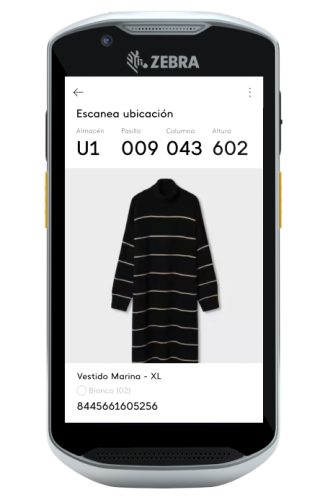
BIG – Evolving a warehouse tool into an operational platform
BIG began as an inventory-focused POC and evolved into an Android platform supporting inbound, inventory, picking and sorting across B2B and B2C merchandise flows. The product had to replace or consolidate existing technical solutions while remaining usable in demanding warehouse contexts.
My contribution
- Defined MVP and MMF scope with Product and Engineering.
- Redesigned inbound, inventory, picking and sorting workflows.
- Conducted discovery and validation with warehouse users.
- Defined behaviour for mobile and Zebra devices and their relationship with back-office processes.
- Analysed product events and operational feedback to guide iterations.
- Documented functional decisions and supported implementation with development teams.
Impact
- 1.23% reduction in picking shortages
- 3% reduction in put-away and picking time
- 57.7 hours saved per week through batch closing
A decision that changed the solution
An independent back-office application had already been proposed to cover a new operational need. Rather than accepting the requested solution, I promoted a discovery process to understand the underlying problem and explored whether the existing platform could support it.
The resulting proposal integrated the necessary capabilities into BIG. The standalone back-office development was cancelled, and the estimated effort was reduced from approximately two months to one sprint.
User Interface
metrics
Throw DXC, Firebase, and interviews data events we get after our iterations:
- 1,2% increasing of stock accuracy on ODC
- 90% increasing of inventory execution
- 0,8% decline of picking faults
- Increase user satisfaction of usability and accessibility
key takeaways
Main lessons I have learned working on both squads are:
- I’ve validated that I can work with new technologies (RFID) and no previous experience complex processes (global distribution).
- How important it is to «get out of the office» and interact with all possible user types regularly.
- To drive Retrospectives and other Scrum methodologies to get a great working environment
- I’ve confirmed how necessary is documentation on Confluence, and the problems of the lack of it
- AI update of latest releases, trends and tools


let’s connect
Please don’t hesitate to reach out if you would like to have some more information. I will do my best to respond to you in a timely manner. Thanks!